Wednesday, November 4, 2015

Indie Memphis Film Festival '15: Sean Baker's Tangerine


Much of the hype surrounding Sean Baker's Tangerine has involved how it was shot (with 3 iPhone 5s smartphones), and while that is unquestionably impressive, what stands out most to me about the picture are the performances by the two leads, Kitana Kiki Rodriguez and Mya Taylor, neither of which had any acting experience. But sometimes portraying the hardships of real life doesn't require the ability to act, and the fact the camera is so small you can barely see it can make it easy to forget it's even there. Tangerine is also unique in that it's one of the first movies I can recall that revolves specifically around the lives of transgender characters, making them into complex, believable people instead of goofy supporting characters. The movie sends them dangerously close to ridiculous comedy on a few occasions, but Baker's intentions are always empathetic. He wants us to truly understand the day-to-day struggle a transgender person has to face.

Sin-Dee (Rodriguez) is fresh out of prison and learns via her best friend Alexandra (Taylor) that her boyfriend/pimp has been cheating on her. This information thrusts Sin-Dee on a quest through the seedy streets of Los Angeles to track down the perpetrator who moved in on her man. A parallel story involves Armenian cab driver Razmik (Karren Karagulian), supporting a family by constantly driving around a bunch of idiotic Americans while secretly embracing his desire to spend private time with the transgender prostitutes on his route. Inner cutting the two stories together proves to be a fascinating device, as we are able to view two unique, yet startling similar forms of oppression due to a larger population's lack of understanding.

Both sides are not without their issues. Once Sin-Dee finds the woman her boyfriend was messing with, she proceeds to literally drag her around the city so they can confront him. This is amusing for a few minutes, but loses steam real quick. We get a glimpse of a series of Razmik's fares, each of which is some sort of caricature to drive home the ignorance of the people he is forced to deal with. The movie does have some big laughs, to be sure, but they come through the performances and not the pressure of the plot. Rodriguez and Taylor are both fantastic, with the latter having what I felt was the more difficult and challenging role. A scene late in the movie where Alexandra performs to a near empty bar could be Taylor's breakout moment.

The movie looks great. The lush sky of Los Angeles is ever present, always threatening to swallow the inhabitants of the city whole. Baker shoots with an urgency that perfectly matches the constant and chaotic lives of his characters. Though not his first feature, Tangerine feels like a true calling card, proof of a talent with the potential to create something amazing. He needs a bit more control over his material and could use some tighter editing, but even that aside, Tangerine is a movie worth experiencing, if anything for taking us into the lives of a series of outrageously memorable individuals.


Thank you for visiting Hell and Beyond!


(c) Hell and Beyond, 2015.

Tuesday, January 27, 2015

"One eye sees, the other feels." Lee's Best Movies of 2014


Every year, it gets harder and harder to make this list. Is it because the movies are getting better? I think so. When it comes time to compile the best movies of the year, I always discover there were more good ones than I might have remembered, and the great ones achieved that status in such different and unique ways that ranking them becomes maddening. 2014 was a bit of a banner year for movies. There are always at least a few a year that take chances, but last year, boldness was seen in alarmingly large numbers. Not all of these movies succeeded at what they tried to accomplish, and that's okay, since the attempt was so ambitious and groundbreaking and thrilling. If I was to make a list of just the movies I saw last year that tried to look at the medium in a new and exciting way, it would include at least half. And this applied to all ends of the spectrum, from low budget indies, to throwback genre movies, to big budget summer spectacles. Movies gained more respect for their audiences, trying to not only entertain and enlighten us, but to move and challenge. This list, as always, is subject to change...that's bound to happen as appreciation grows for some movies more than others. But for now, I can proudly say that these are the movies that delighted and shook up my senses the most in 2014. Enjoy, and look forward to discussing these more as time moves on...

LEE


Notably Missed (in alphabetical order): Dear White People, Goodbye to Language, Listen Up Philip, Mr. Turner, National Gallery, Starred Up, Stray Dogs, Two Days, One Night

Wish I Could Forget (in alphabetical order): 22 Jump Street, The Interview, Nymphomaniac Vol. 2, Sabotage, Tusk

Wish I'd Loved (in alphabetical order): The Babadook, Birdman, Gone Girl, The Immigrant, Joe, Mood Indigo, Sin City: A Dame to Kill For

Honorable Mention (in alphabetical order): Art and Craft, Boyhood, Captain America: The Winter Soldier, Cheap Thrills, Godzilla, Grand Budapest Hotel, Interstellar, Journey to the West, Kumiko, the Treasure Hunter, Life Itself, Noah, Nymphomaniac Vol. 1, Oculus, The One I Love, The Purge: Anarchy, The Rover, Skanks, Stranger by the Lake, We are the Best!

20-11:

20) Snowpiercer dir. Bong Joon-ho
19) The Raid 2 dir. Gareth Evans
18) Nightcrawler dir. Dan Gilroy
17) Blue Ruin dir. Jeremy Saulnier
16) Love is Strange dir. Ira Sachs
15) Foxcatcher dir. Bennett Miller
14) Edge of Tomorrow dir. Doug Liman
13) Gabriel dir. Lou Howe
12) Enemy dir. Denis Villeneuve
11) Calvary dir. John Michael McDonagh


TOP TEN


10) The Guest dir. Adam Wingard


10) John Wick dir. Chad Stahelski, David Leitch

I couldn't decide which of these was more deserving of making the list, so I cheated and put them together. Like I mentioned in my opening statement, it was a banner year for genre movies, the proof being in the enormously inventive and entertaining The Guest and the sleek, ultra cool John Wick. One is an action/horror/sci-fi hybrid led by the commanding presence of Dan Stevens and the other, a shoot-em-up that might make John Woo blush and confirms that even at 50, Keanu Reeves is still a badass. Interestingly, both movies largely live on the charisma of their stoic leading men.


9) Whiplash dir. Damien Chazelle

Blood, sweat, and tears each play equal parts in this riveting, tightly wound drama that's a masterclass of editing, direction, and performance (I kept waiting for J.K. Simmons's skin to burn off and reveal a literal demon within). You'll never look at goal reaching obsessions the same way again.


8) Selma dir. Ava DuVernay

David Oyelowo effortlessly disappears into the role of Dr. Martin Luther King Jr. in a rare biopic that, instead of trying to squeeze an entire life into two hours, focuses on a key event that tested King's will and leadership. Aside from being a powerful look at the politics that hugely influenced the decisions made during the Civil Rights movement, Selma wins major points for showing that King, in addition to being a vigorous speaker, was at his core still a man, which we are able to see, flaws and all.


7) Dawn of the Planet of the Apes dir. Matt Reeves

A sequel to a reboot that actually manages to create real emotion involving a colony of CGI apes. Director Matt Reeves, who between this and Let Me In (also a remake), is quickly on his way to auteur status. He gives each of the characters, human and ape, more depth than one would have imagined possible. When the action occurs, it has real weight to it, and Andy Serkis, who was motion captured to bring Caesar, the head ape, to life, is worthy of praise simply for what he's able to convey through wordless expression. It's a stunning performance and is the backbone for a movie that is, for lack of a better word, Shakespearean.


6) Guardians of the Galaxy dir. James Gunn

Remember when summer movies were fun? When they didn't try to assault your senses with hyper camera work and editing? So does James Gunn, who takes the space opera to new levels of awesomeness. The new Star Wars picture has big shoes to fill.


5) Only Lovers Left Alive dir. Jim Jarmusch

Jim Jarmusch has always made movies that are subtle and cool, but rarely have they felt as naturally cool as this one. Just when you thought there was no other way to tackle the vampire genre, Jarmusch swoops in and casts Tom Hiddleston and Tilda Swinton (both amazing) as a couple of bloodsuckers who actually try to avoid humans, mostly due to their ignorance when it comes to art and artistic expression. This is not a horror movie, but a sly and often insightful drama about mourning the past while weeping for the future.


4) Inherent Vice dir. Paul Thomas Anderson

Paul Thomas Anderson's movies are comparable to visiting a foreign land in that they fascinate, exhilarate, and occasionally frustrate. I more often than not adore his work, although I am still scratching my head over the praise aimed at The Master (I still owe it a second look, as the movies of his I love have always enhanced with repeat viewings). Inherent Vice feels like a perfect match for Anderson from the start, with its period setting and characters who are just this side of normal. They're searching for something, as they always are, but the tricky part this time is that the country is changing around them, creating an environment of subtle chaos. Life is just happening, man, especially for the hero(?), Doc Sportello (Joaquin Phoenix), who is lost in a haze of smoke and depending on people who are just as clueless as he is. Anderson paints the characters, creations of novelist Thomas Pynchon, with an incredible level of sympathy, at the same time dropping them in a beautifully constructed Vietnam era California beach community. It's the perfect place to be drifting through life, especially while waiting to see what surprises (good or bad) await. Inherent Vice is all about the journey; where it leads is the ultimate mystery.


3) Ida dir. Paweł Pawlikowski

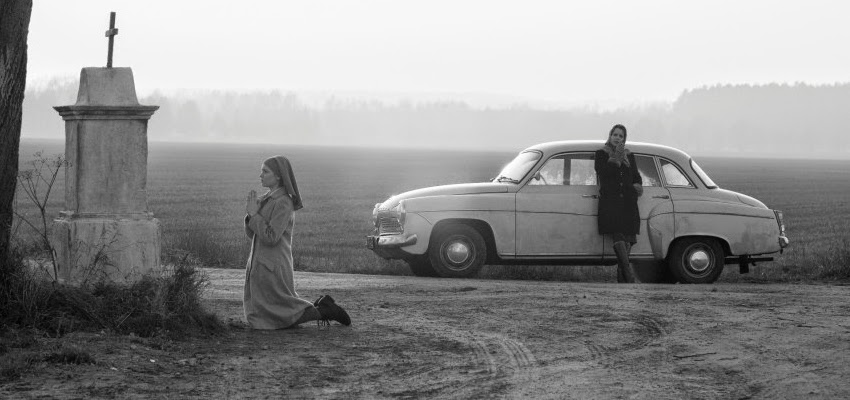
A story of self-discovery unlike any I have seen, mostly due to the jaw dropping black-and-white cinematography by Ryszard Lenczewski and Lukasz Zal. In Ida, the visuals add an extra level of thematic richness to the story of Anna (Agata Trzebuchowska, in a stunning debut), a nun awaiting her vows who leaves the convent to learn the truth about her family's history. Painful secrets are uncovered, of course, but the haunting beauty in which they are revealed, along with Anna's recognition of who she is, are profound and achingly moving. Ida is a rare movie that truly is an experience.


2) Under the Skin dir. Jonathan Glazer

One of the movies' biggest sex symbols, Scarlett Johansson, plays brilliantly against type in an astonishing near wordless performance as a "being" that cruises the streets in hopes of finding out what makes us human. The quest begins in a purely sexual nature, but a series of events, the most chilling involving a group of people's failed attempts to save each other from drowning, leads her to practice our everyday habits. Director Jonathan Glazer, in his third feature in 14 years, pulls off some of the most frightening and tragic images I've seen in many a moon. Johansson's seemingly emotionless creature learns all too well the complexity and weaknesses involved with being human, and the dire consequences that come from our tendency to destroy that which we don't understand. Under the Skin is the best kind of science fiction in that it asks difficult questions without providing easy or simple answers. It's extraordinary.


1) Force Majeure dir. Ruben Östlund

Appropriate that Force Majeure begins with an avalanche plummeting down a mountain, since I felt like I'd been hit by one throughout much of the movie's run time. And that's a compliment. Of all the movies I loved in 2014, this is the one I've been most eager to discuss. Through a series of awkward, embarrassing, and sporadically hilarious conversations (sometimes all at once), we witness what happens when a man's dignity and trustworthiness are questioned and even doubted. There are consequences to our choices, some that we can't accept or don't want to admit to. Part of the genius of Force Majeure is how the decision of one man trickles down and causes others to put themselves in his position, with potentially disastrous results. Funny how your whole life can change in an instant based on a gut reaction, and everything you've done before that moment and after are being questioned. The movie holds us hostage as a husband and wife are forced to deal with the fact they see (or choose to see) a catastrophic event in a drastically different way, often in long, uninterrupted takes that give us no choice but to face the music with them (and those around them, including their two children). A lot of intriguing questions are raised and appropriately, there are no easy answers. Just a lot of "what ifs." There are many great movies about the complexity of relationships. Put this one at top of that list.


Thank you for visiting Hell and Beyond!


(c)Hell and Beyond, 2015

Tuesday, November 18, 2014

David Cronenberg's The Fly


Howard Shore's score immediately sets the tone for The Fly, letting us know we are in store for a tragedy even before we've met any of the characters. It hits a string of dramatic highs that almost suggest that of an opera, not surprising since the director, David Cronenberg, and Shore adapted this movie into one years later. After the credits end, the movie wastes no time and sends us straight into the middle of a conversation between Seth Brundle (Jeff Goldblum, in a career defining performance), an ultra nerdy scientist, and Veronica Quaife (Geena Davis), a journalist for Particle Magazine. Much flirtation is involved, and Seth is finally able to convince Veronica to come back to his lab to see what he's been working on. What first seems like a bad pickup attempt quickly turns into the story of a lifetime. Seth has found a way to teleport inanimate objects; at least, that's all he's tried it on thus far.

Veronica is, naturally, astonished by what he's done, and begins to fall in love with Seth in the process. They have an effortless chemistry, one built on physical and mental attraction. For Veronica, the idea of doing a story on him has become replaced with a genuine interest in seeing his new invention prevail. But that will involve testing it with a living subject, or "flesh," to use a signature word of Cronenberg's. After a disastrous attempt and a few modifications, Seth makes a breakthrough that ends with him being the first human test subject. Due to a distraction based on jealously (Veronica is in a complicated situation with an ex-boyfriend), Seth fails to notice that a fly is in the teleportation pod with him.

At first, Seth feels miraculous. He can have sex for hours, his strength has increased significantly, and he'd probably be a shoo-in for the Olympic gymnastics team. But what to make of the endless sugar cravings, the tough hair growing on his back, and the change in his skin tone? It's easy to brush such things aside when you've made an epic scientific breakthrough and feel like a teenager again. Veronica notices the changes in the way Seth looks/acts, but her attempts to make him aware end in confrontation. He wants to believe that she's jealous of his discovery and the power it's brought him. He wants someone to share the rush of the experience with him, which Veronica refuses to do, especially when Seth starts to literally fall apart.

Seth's deterioration is shown in graphic detail. It has been speculated that The Fly, released in 1986, is a cautionary tale about AIDS, a theory Cronenberg has denied was intentional. Given Seth's physical state as the movie progresses, it makes perfect sense. Everything takes a complete turn for the worst for him, beginning with the skin and then leading to basic motor functions. His fusion with the fly has plagued him like a disease, and it's heartbreaking to watch Seth desperately try to find a way to scientifically save himself as he continues to come to pieces. As with his 1982 feature Videodrome, Cronenberg wants us to see the extreme consequences that arise when man feels the urge to become a part of their technological advances. What sets The Fly apart from that movie is the love story at its center.

There's an exciting urgency in the romance between Seth and Veronica. The flirtation and teasing that establishes their attraction soon builds into mutual respect and for Veronica, it goes a step further in seeing Seth get the attention he deserves for his creation. The test of unconditional love is taken to its fullest extent once Seth begins to change and Veronica has to decide how far she can go. A revelation late in the movie adds an extra complication that drives Seth further into madness. By the time he's almost fully transformed from man to fly, his obsession with becoming human again has caused him to consider acts that could jeopardize the one person who truly cares for him.

The breakdown of Seth's mental state and his internal/external body changes add to The Fly an interesting take on the aging process. It's a tribute to the complexity of Goldblum's performance that he is still able to convincingly show so much sadness despite being hidden under lots of makeup. Once he finally accepts that he is no longer fully human and, like aging, it is something out of control, the movie finds real sympathy in the midst of the grotesque. There are a number of truly shocking sights in the movie, most of which are drawn out of the "fly" side of Seth's being, and what's surprising is how he is able to do his best to treat this misfortune as something he can adapt to (look at how he documents his method of eating once his digestive system has changed). Even as his world comes crashing down, it's still all about science, as witnessed by how Seth saves all the body parts he loses.

It's astonishing to me that The Fly was a big summer studio release. Unlike most crowd pleasing blockbusters, Cronenberg's movie, despite its high caliber special effects, is grim and features a conclusion that is undeniably heart shattering. The movie stunningly pulls off the remarkable feat of getting us emotionally connected to the fully transformed Seth, who is no longer a man (in appearance, at least, as the tortured soul of the man still exists within) by the end of the picture. The final moment is devastating, made so due to the fantastic performances by the two leads and Cronenberg's dedication to play this material without a hint of irony. No one can devastate us like he can (just look at Dead Ringers if you still don't believe me). How fascinating it is that his ultimate masterwork also turned out to be his most commercial.


Thank you for visiting Hell and Beyond!


(c) Hell and Beyond, 2014

Friday, November 14, 2014

David Lynch's Eraserhead


The 1970s is the greatest decade in American film, not just because the movies started taking more chances, but more so due to the effect the Vietnam War had on the country. Our whole mindset changed; gone were the days of innocence and the urge for a white picket fence and a shiny new Buick. Gone were the days of Flower Power and America as a land of endless opportunity. People started to question things, like gender roles, race relations, and the necessity to get married and have children. It was like a new world, this homeland of ours, and a crop of budding filmmakers were ready to tackle the shifting tide like never before. All genres got involved, none quite as subversively though, as the horror movie. Since they often play without rules, it gave the filmmakers more room to let their imaginations run amok.

Arguably the first horror picture to really challenge us with societal issues was George Romero's Night of the Living Dead. From there, a hefty crop of movies followed suit, each one dialing its extremities up to 11. Just look at The Exorcist, which was supposedly responsible for causing pregnant women to miscarry! Or The Texas Chain Saw Massacre, with its documentary style that makes us feel as if the demented family at its center could be living right next door. Scary stuff, to be sure, and even if these movies were not direct influences, they helped pave the way for David Lynch's first feature, Eraserhead.

Having just given Eraserhead a fresh look, I don't think it would be out of place on a double bill with Texas Chain Saw. Both movies, in their own way, are savage critiques of the American family unit, post-Vietnam. But while Tobe Hooper's movie focuses more on the ritual side (every one playing their role, family meals), Lynch's is about the terror of realizing that you have a family and are stuck with them. You might as well even say that the title character, named Henry (Jack Nance), has just returned from war. An early scene shows him walking home with a grocery bag, the landscape around him desolate and ugly (often the visual style used to project moral deadness). Once he arrives back at his tiny apartment, a neighbor tells him that a woman named Mary (Charlotte Stewart) has invited him to dinner. When Henry gets to Mary's house, he complains that she hasn't come around in a while (they've been apart, much like when a soldier has been overseas).

What follows is the terrifying moment where Henry is forced to meet his future in-laws, complete with a chicken dinner that has to be seen to be believed (like Texas Chain Saw, there could be a strong anti-meat message going on here). Not long after, Henry learns that Mary's had a baby (prematurely) and that he must marry her. Before he can blink, Henry's one room apartment just got a little smaller thanks to his new wife and baby. The pressures of responsibility and duty (you're a grown man, so it's time for you to get married and have a family of your own!) has invaded Henry's life, not to mention his vacation from work. We see the irritation that grows from sharing a bed with someone when you're used to sleeping alone, plus the intrusion on sleep thanks to a constantly crying baby. Henry is obviously ill equipped to take care of his child (which looks like a sick animal). He takes its temperature, and after coming to the realization something really is wrong, he has no idea how to handle it.

When you describe the set up of Eraserhead, it sounds like elements of a bad romantic comedy. What sets it apart, of course, is the fact it was made by David Lynch, whose movies excel at peeling the nightmarish layers off of American life. He presents his subjects with a mixture of heightened melodrama, bizarre comedy, and mind blowing (and occasionally numbing) visuals. The sights in Eraserhead are some of his most disturbing and mystifying. Look, for instance, at the recurring sexual imagery, all of which is displayed in the least erotic or appealing way. Most of it resembles sperm, and varies in size (the seeds get bigger as the movie progresses, almost as if they might eventually ingest Henry). Lynch tries to make anything sexual in the movie look as grotesque as possible, beginning with a strange shot of what can be presumed as the pregnancy occurring (set in motion by a man pulling a lever...God?) and later in a dream sequence that could be interpreted as Henry performing an abortion on Mary.

Henry is almost constantly in what appears to be a dream state. His greatest escape from responsibility involves a puffy cheeked woman who dances in his heater and at one point, violently stomps on sperm that have fallen from the sky (Is she a guardian angel? There are other hints that suggest the answer could be yes). Most of Henry's fantasies contain destruction of sperm and worse, the image of his head replaced with that of his deformed child. It's a literal removal, with his severed head being stolen and used as a tool to delete an act of creation. Scenes like this show Eraserhead to be a deeply personal movie, the work of a man who used art as a way to grapple with his own inner demons.

It's the personal nature of Lynch's images that often make them so difficult to decipher. This is not a weakness; if anything, it proves Lynch to be one of our most gifted filmmakers, since he is able to so vividly let us run loose inside of his head, even if it means we may not like or understand what we see. I believe there is a meaning to it all, even if I can't always figure out what is and he won't tell me. Like an actual dream, sometimes you're freaked out and you don't know why, and that's makes it all the scarier. Eraserhead is one of Lynch's best movies, stunningly made from a technical standpoint (the lighting design is almost a character by itself) and constantly absorbing to the eyes. Like any great horror movie, it thrives on deep human fears (marriage, parenting, infidelity), and does so as we had not seen then, and rarely do now. It's refreshingly unapologetic and existentially terrifying.


Thank you for visiting Hell and Beyond!


(c )Hell and Beyond, 2004

Wednesday, November 12, 2014

Stuart Gordon's Dolls


Director Stuart Gordon followed up his batshit crazy H.P. Lovecraft adaptations, Re-Animator and From Beyond, with Dolls, a deceptively simple but delightfully twisted haunted house movie that may seem out of place with the rest of his work (you can tell it was a director-for-hire job), but is still hard to ignore. If it lacks the psycho sexual elements and crazy gore of his earlier two features, it all but makes up for it in chilling atmosphere and demented looking toys. Gordon's touch is undeniably there, as we see early on during a strange sequence involving a giant teddy bear that sheds its fluffy shell to reveal a ravenous beast underneath.

The setup is as threadbare as it gets. Unpleasant couple David (Ian Patrick Williams) and Rosemary (Carolyn Purdy-Gordon, Stuart's wife) are on vacation with his young daughter, Judy (Carrie Lorraine), when their car gets stuck in front of an old mansion. Evil stepmother Rosemary complains about the kid being there, even throwing Judy's beloved teddy bear in the woods as they begin to trek through the pouring rain to shelter. Once inside the house, they are welcomed by the owners, Gabriel (Guy Rolfe) and Hilary (Hilary Mason), a strangely cheerful elderly couple who also happen to be doll makers and believe in the concept of always being a child at heart. Also joining the party is clueless drifter Ralph (Stephen Lee) and two punk rock hitchhikers (Bunty Bailey and Cassie Stuart) he picked up.

Once everyone's been shown to their rooms, Dolls really gets moving. The start of it has a nice slow build as the dimly lit hallways of the mansion are established, complete with Gabriel's creepy-as-hell dolls peering out of the darkness in every room. That feeling the eyes are following you is brought to literal life here and naturally, Judy is the first one to notice the dolls are alive. No one believes her, even after the adults start getting attacked. The violence in the movie is surprisingly effective given the absurd fact it involves toys. My personal favorite kill involves a firing squad, while I was also disturbed when a character is ambushed by a horde of angry dolls coming from all directions.

SPOILER

What stands out most about Dolls is its message about the punishment dished out to those who have grown up and lost their sense of adventure and imagination. We know Judy will be safe since she's a child, but the adults who mock her are killed and then turned into dolls themselves! This is shown in graphic detail when a character smashes a doll's face and beneath the porcelain lies a zombified skeleton. Even more bizarre is a scene where a character's already transformed face loses its eyes and they struggle to retrieve them from a pool of blood on the floor.

SPOILER END

Thanks to Gordon and the efficiently witty script by Ed Naha, Dolls is a little more ambitious than the usual low budget horror offering. It would also be the beginning of producer Charles Band's obsession with evil playthings (he later released Puppet Master and Demonic Toys, to name a few). I like some of the other movies he's made in this genre, but none of them share the old school location of this one, with its creaky doors and narrow corridors. There's also something lovely about the stop motion effects by the late David Allen, who gives the dolls somewhat jerky movements that add another level of menace to go with their already ominous faces.

The real stars of Dolls, though, are Guy Rolfe (who later starred in a few of the Puppet Master movies) and Hilary Mason (the blind psychic in Don't Look Now). Pulling off sincerity with a hint of cynicism is not an easy thing to do, yet these two achieve it effortlessly, even when it comes time for them to let on what's really happening in their house. I also liked the friendship that develops between Judy and Ralph. He's the only adult who hasn't lost his childhood spirit, and he's played by Stephen Lee with a terrific knack for physical comedy.

Dolls might not be Stuart Gordon's best film, but it is a welcome addition to his filmography. I had not seen the movie since my early teenage years, so I was expecting to enjoy it for nostalgia purposes at best. Imagine how pleased I am to say that the movie still works quite well on its own terms. Good horror movies are rare, and entertaining ones, especially in a genre like this, are even rarer. Dolls fills its quota on both counts, and at a brisk 77 minutes, it doesn't run the risk of wearing out its welcome. Given how often horror movies let us down, the fact that this one actually gives us what we pay for is somewhat of a blessing.


Thank you for visiting Hell and Beyond!


(c)Hell and Beyond, 2014

Tuesday, November 11, 2014

Christopher Nolan's Interstellar


SPOILERS THROUGHOUT


I can't think of another big budget filmmaker out there as ambitious, in visuals and in subject matter, as Christopher Nolan. His detractors spend their time poking holes in the movie's plot or criticizing how accurate certain details are, completely overlooking the bigger picture. Nolan likes to grapple with intense subjects, often from too many angles, but there's a passion in his work that proves that plot points are not always the most important pieces of the cinematic puzzle. Even in his low budget early features, Following and Memento, there was already evident a sense that this guy had much grander projects in store. He wants to take us places we haven't gone before, and if we have, he's going to ensure we experience it in a way that is fresh and new.

Nolan's latest movie, Interstellar, does just that. It introduces elements we are familiar with in the movies, and manages to bring them to life with an enhanced level of human interest and wonder. As is often the case, Nolan and his writing partner (and brother), Jonathan Nolan, have so much they want to share with us that the screenplay gets overstuffed. But I'll get back to that later. First, I want to focus on what really worked for me about this movie. Fascinatingly, Interstellar opens in the future, but we'd never expect that since the world looks precisely as it does today. Mankind is on the verge of extinction, although instead of conveying that through post-apocalyptic visuals (the closest thing we get are dust storms), Nolan keeps it simple and feeds us tidbits of information through dialogue. Instead of showing global suffering, the movie keeps things intimate and focuses on one family.

Cooper (Matthew McConaughey) is, like many others, a corn farmer, as all other crops are extinct. He's a widower raising two children, Tom (Timothée Chalamet) and Murph (Mackenzie Foy). His deeper bond is with Murph, as she shares his love for science. It is this love that leads her to discover a code that gives the coordinates to NASA, who is now hiding underground and has a proposition for Cooper. With life on Earth dwindling away, mankind is going to have re-populate elsewhere, and several potential planets have been found. NASA needs Cooper to fly a shuttle through a wormhole and visit each one to see which will be inhabitable. The catch, of course, is that he'll have to leave his family and perhaps never see them again.

This within itself would already be an intriguing set up for a movie, but Interstellar takes things up a notch by adding the complication that after going through the worm hole, and when landing on the other planets, time will move at a slower speed than that on Earth (an hour in space can amount to years on Earth). This aspect, for me, is the heart of the movie, since we know that the mission is not going to run as smoothly as it should and Cooper will have to face the fact his kids will be older than him if he makes it back. It doesn't help that Murph is so angry with him for leaving her behind that they part ways on bad terms, something that Cooper always regrets. There's a gut wrenching scene late in the picture where he is able to relive their last conversation, and he watches with horror as he makes the decision to walk away from his daughter again.

At its best, Interstellar is a movie about dealing with loss, regret, aging, and even more specifically, your children aging faster than you. There's a great deal of pain built into the scenes where Cooper and his second in command, Brand (Anne Hathaway), watch videos sent by their loved ones, the space between them seemingly infinite. Never before has the gap between the viewer and their tiny screen felt as vast as it does in these moments, especially when Cooper receives the first transmission from Murph as an adult (played by Jessica Chastain). At its core, this is a movie about the power of love, about how it transcends time and space. Sound ridiculous? It is, but Nolan directs it with such conviction, and his cast is so achingly committed, that the feelings displayed through visuals and performance feel completely real. It doesn't hurt that Hans Zimmer's score adds an extra (and welcome) level of melancholy.

If only Nolan had kept his focus on that. He and Jonathan are good writers, but as their projects have grown, they tend to throw too many elements into the pot, and with that comes an often exhausting amount of exposition. This was first apparent in Inception, which told so much when it would have been more beneficial to show us instead. This time out, there are scenes filled with talks of physics and relativity and worm holes that get so detailed that I needed a rewind button to make sense out of it. And why have so much scientific explanation anyway? It just feels like an excuse for Nolan to beat us over the head with how much research he did and to make sure the purists in the audience won't call a foul.

One of the big surprises of the movie is the subtlety of the visual style. The full scope of being in space is realized, to be sure, but instead of going all out on dazzling special effects in every sequence, Nolan keeps the big stuff under wraps until the last third. Until then, most of the scenes are kept in the confined quarters of the shuttle, as if we're supposed to be enveloped in the worries and loneliness of the characters and forget that nothingness surrounds them. It gets under the skin as the movie progresses, making us grateful once Cooper and his team finally do find land. Even here, Nolan holds back. The first planet is covered in water, the second, with ice.

Cooper finds a ship already on the ice planet, complete with a survivor sleeping inside. His is one of several red herrings revealed to show the desperation of self survival and the way authority figures lie to us when they don't really have a solution. The confrontation on the ice planet is one of the clunkier segments in the movie, nice to look at it but heavy handed in execution. Nolan has already made his point about man's need to save himself, so the sequence feels unnecessary. Much more rewarding is the climax once Cooper passes through another worm hole and is able to revisit moments of his past with Murph.

The movie's final section proves that it holds more value as a human drama than a science fiction movie. I say this because Nolan doesn't seem interested in explaining or exploring the how's and why's of the new planet where humanity has started over. We just get brief glimpses of it, with some of the visual ideas taken straight from Nolan's own Inception. There's real tenderness, however, in the still youthful looking Cooper reuniting with Murph, now an old woman on her deathbed. Seeing each other again is a gift, one that Cooper was willing to risk in order to ensure she and her future generations would be able to continue to thrive. It's the most lovely and emotional moment of Nolan's career thus far, earned due to the strength he builds in the bond between this father and daughter.

So how does one sum up Interstellar, a movie that wants to have its cake and eat it several times over? Even if it lacks the overall impact of Nolan's best movies (The Dark Knight trilogy, Memento), it shares with them a true understanding of human nature, our constant struggle between doing what's right and doing what's best (and if they're the same thing). Men are always at odds with themselves in the worlds Nolan creates, and with each new movie, he finds ways to challenge and frustrate us like no other filmmaker around. Even if his movies rarely hit it completely out of the park for me, I feel lucky to have him. Interstellar, warts and all, joins a long list of movies in 2014 that have reached further than most movies dare. I can't wait to see it again.


Thank you for visiting Hell and Beyond!


(c) 2014, Hell and Beyond

Thursday, November 6, 2014

Alejandro González Iñárritu's Birdman or (The Unexpected Virtue of Ignorance)


Michael Keaton gets his first starring role in many a moon playing Riggan Thomas, a 60-year-old has been actor whose glory days peaked twenty years before, thanks to an action movie franchise known as Birdman. Since that's all he's ever been known for, Riggan decides it's time to make a desperate (and costly) attempt to show himself as not only a serious actor, but also as a writer and director. He's staging a play based on a short story by Raymond Carver (who inspired him to become an actor), and Alejandro González Iñárritu's film is about his attempt to pull it off. Subtlety has never been Iñárritu's strong suit, which he proves again here, although he does hit some grace notes along the way.

Most of the movie takes place backstage at the theater, structured in a way for us to experience all the pressure and suffocation that Riggan and his fellow cast members go through as they prepare for the period from preview show to opening night. All the archetypes are covered: the pompous leading man (Edward Norton), the insecure actress (Naomi Watts), the actress Riggan is sleeping with (Andrea Riseborough), Riggan's fucked up daughter (Emma Stone), and of course, his long suffering yet sympathetic wife (Amy Ryan). I found most of the performances engrossing; the weak link is Zach Galifianakis, type cast as Riggan's nutty lawyer and best friend. But the others keep the movie afloat, especially Keaton, Norton, and Stone, who manages to breathe some depth and history into her stock character.

The screenplay is painfully overwritten. The characters criticize each other, lecture each other, and support each other in a series of speeches that try to make it very, very clear what the meaning of it all is, in case for some reason we missed it the first few times. One of the most cringe inducing moments comes when Riggan's daughter goes on a long rant about how nobody is important, followed closely by a run in Riggan has with a stuffy theater critic (Lindsay Duncan). Because it's all about self sacrifice and showing the world you still matter! Get it? And criticism exists to humiliate people who are out there trying to bear their souls! Get it? Oh yeah, I got it. Iñárritu makes certain I will not forget.

SPOILER ALERT

Cinematographer Emmanuel Lubezki does a splendid job capturing the need to escape the narrow halls of backstage theater, and what a relief it is finally be on stage, where a whole new type of fear awaits. There are moments where Birdman or (The Unexpected Virtue of Ignorance) is able to nicely convey these hardships as well, such as when a preview show is ruined by a drunken outburst, or when a couple making out above the stage transitions down into a live performance. I even was grateful for some of the quieter moments, like late in the picture when Riggan makes a confession to his ex-wife about the night he cheated on her or Norton's leading man trying to size up Riggan's daughter on the theater rooftop. But for every two of these, there are a half dozen more that force feed the nature of things to us. Even the shooting style, which is supposed to make the movie feel like one uninterrupted take, eventually wears thin, to the point we realize that by taking away the stylistic approach, you wouldn't be left with much.

As the events leading to opening night continue to spiral out of control, so does Riggan, and Iñárritu, who has tried to add touches of surrealism throughout, lets the fireworks fly during the final third. So, where the first two thirds of the movie beats everything into our heads through dialogue, the last part tries to make sure we understand what all the voices in Riggan's head have really stood for. It feels like a cheap thrill, a lackluster attempt for a filmmaker out of his element to show us how creative he can be. By that point, though, he'd already lost me, so by the time the movie reaches its inevitable conclusion, there's no sense of wonder left. Keaton is so good here, and the potential of this role is so rich that it's a shame to see it wasted on a bunch of overblown observations about being washed up. What could have been profound ended up, for me, as a series of shrugs.


Thank you for visiting Hell and Beyond!


(c) Hell and Beyond, 2014