Friday, November 4, 2016

IMFF '16: Ira Sachs' Little Men


Few filmmakers working right now understand the complexity of human relationships quite like Ira Sachs. His movies often tackle difficult situations, but he explores them with a sense of realism we rarely get to see. Hearing Sachs explain that he does not rehearse with his actors and that they do not recite their dialogue aloud until they are on set is a testament to why his characters feel so lived in. It's a refreshing change of pace, as most character dramas have to hit a series of beats, most often climaxing with a serious conflict and at least one big emotional moment. Not that those don't happen in real life, mind you, but Sachs tends to keep the action on the more even tempered side.

Sachs' latest work, Little Men, is able to, in the span of barely 85 minutes, effectively examine the lives of two children and their attempt to understand the behavior of their parents. Thirteen-year-old Jake (Theo Taplitz) becomes fast friends with Tony (Michael Barbieri) following the death of Jake's grandfather. Their budding camaraderie is shown through a mutual love of the arts; Jake enjoys drawing and Tony wants to be an actor. What's refreshing about this is that their parents actually encourage and support them where in a lesser movie, they would discourage them. In Jake's case, this support probably comes from the fact that his father, Brian (Greg Kinnear), is a struggling actor. His mother, Kathy (Jennifer Ehle), is a therapist and the sole bread winner, and while the movie could have created tension out of that, instead it shows a healthy marriage based on trust and understanding.

The boys budding friendship is tested when it looks as if Brian might have to evict Tony's mother, Leonor (Paulina Garcia), from the dress shop she runs because he now owns the building and has to raise the rent. The question of how far one's generosity can stretch is tested here, particularly if it means looking out for one's own family first. Sachs stages a series of difficult conversations between Brian and Leonor in which he states what is financially right while she is only concerned with what feels morally right. It puts Brian in an uncomfortable place, not just because of what she meant to his recently deceased father, who was letting her run the shop even though business was slow, but also because of how it could affect Jake and Tony's friendship.

The title refers, I think, to Jake and Tony's painful discoveries regarding adulthood, as well as Brian's struggle to be a good father and set an example for his son. There are moments when father and son clash here when each doesn't know what the other is going through, and those scenes are complimented by conversations that beautifully show how powerful honesty and communication can be. Look, for example, late in the movie where Brian gives Jake a pep talk on why he needs to keep drawing. Or a scene in the kitchen when Jake is discouraged over some of his artwork that possibly got thrown away. Sachs is able to bring the same level of pathos to the subtle exchanges between Jake and Tony, such as when Jake finds out Tony got beat up at school.

In the midst of all these relationships is the movie's setting, Brooklyn, which becomes a character of its own long before the movie is over. This atmosphere clearly has an affect on those who inhabit it, adding an extra layer to the weight of the emotions conveyed. In the course of only six feature films, Ira Sachs has managed to successfully explore a variety of different types of people, young and old, and express not only the intricacies of their interactions, but how the place they live shapes who they are. Little Men is one of his very best movies, a testament to how film can serve as a window into the lives of others who go through the same trials and troubles that we do.


Thank you for visiting Hell and Beyond!


(c) Hell and Beyond, 2016.

Thursday, November 3, 2016

IMFF '16: Kirsten Johnson's Cameraperson


Kirsten Johnson has shot close to 50 documentary films over the past 25 years, many of which deal with harsh subjects like rape and mass murder. Footage from her body of work is what comprises Cameraperson, yet anyone worried about seeing any of these atrocities onscreen can rest easy. Johnson's role was in talking to the survivors. Her projects have taken her all over the world, ranging from Bosnia to Nigeria to Alabama. The clips are often very short and feel incomplete, and in some cases, Johnson returns to them. Many of the clips that appear side by side share a thematic thread, such as viewing how people in different parts of the world are dealing with the aftermath of a sexual assault. Sometimes we see two different perspectives, like when a young African American woman struggles to explain why she needs to get an abortion and then later in the movie, we visit a Nigerian clinic where a midwife desperately tries to keep a newborn alive.

While it is easy for much of the footage to seem randomly thrown together, we eventually realize it is not, especially when Johnson brings in clips of her mother shortly before she died after a battle with Alzheimer's. We meet her children. Despite so much of her personality being evident throughout the movie, Johnson herself only appears onscreen once. But that doesn't mean we don't get to know her as the movie progresses. Cameraperson is not just the chronicle of a career, but a deeply felt portrait of how this filmmaker came to see the world. We are now experiencing the lives and behaviors of multiple cultures just as she has, and the effect is nothing short of mesmerizing. Just like Johnson, we have empathy for the people sharing their thoughts and feelings, especially when it comes to expressing how they deal with the conditions they live in (such as two women explaining why they have to cut down a dead tree for firewood).

Johnson is rarely heard speaking either, only asking questions or giving "direction" on a few occasions. We are reminded that even though this is real life we are seeing, there is also a movie to be made. I was quite amazed at some of the footage Johnson was able to get and how candidly some of the subjects spoke with her. It's a testament to her not only as a filmmaker but as a human being, as I can't always imagine it was easy for some of these stories to be told (there's a scene involving a young man describing how he lost sight in his left eye that is gut wrenching). As I mentioned, all of this is intercut with Johnson's own family, possibly as a way to bring her back to her own reality. Or could it be a way to preserve the memories should her fate be the same as her mother's? Cameraperson is a very special movie, one I will never forget and am anxious to see again. Given the way it is structured, there will be always be a wealth to rediscover. It is unquestionably one of the most unique and unforgettable memoirs I have seen. I urge you to watch it on the biggest screen you can find.


Thank you for visiting Hell and Beyond!


(c) Hell and Beyond, 2016.

Wednesday, November 2, 2016

IMFF '16: Hometowner IndieGrant Shorts


Here are brief thoughts on the short films made by last year's IndieGrant winners. While my enthusiasm for them varies, there's no question this is a thoroughly talented group of filmmakers that Memphis is lucky to have. I look forward to seeing more work from each of them in the future! To learn more about IndieGrants, click HERE.

Death$ in a $mall Town dir. Mark Jones

A savagely funny look at how a new mayor decides to generate revenue in his town. Corey Parker (ahem) slays the lead role as he convinces the townspeople that sometimes, death is the answer.

Returns dir. Joseph Carr

An offbeat portrait of employees suffering through the slow demise of the bookstore where they work. While it is overlong and a bit too on the nose in spots, this is a subject that is very dear to me, so its often frank disgust certainly resonated. Cynical without being off putting.

On the Sufferings of the World dir. JEBA

Voiceover poetry by Arthur Schopenhauer collides with overlapping images of two women falling in and destructively out of love. The pretty faces are unable to mask the headache inducing effect of the style, which may be the point, but it all feels artsy for artsy sake.

Broke Dick Dog dir. GB Shannon

Three African American men, each with different mothers, track down the man they all believe to be their father at the radio station where he works. A potentially poignant story is marred by an uneven tone, with the early almost farcical moments not mixing fluidly with the dramatic arc that follows. Beautifully shot, though.

Silver Elves dir. Morgan Jon Fox

Visually haunting journey of a young man's disappearance loses its power by deciding to show news footage of his parent's grief. Think this would have been much more effective had it stuck to the setting; taking us out of the main character's environment breaks the spell.

Dirty Money dir. Jonas Schubach

Highly amusing in how it shows the various fantasies a mall janitor has after finding a bag full of money stashed in a bathroom stall. This newfound fortune might too good to be true, as he learns once someone else enters the bathroom. The somewhat sloppy style is saved by the ingenuity of the premise and the decision for the movie to be dialogue free.

How To Skin a Cat dir. Laura Jean Hocking and C Scott McCoy

A wacky road trip headed for disaster takes an unexpected detour. Highlighted by a flat hilarious performance by Billie Worley and some clever writing. While I might not have enjoyed the payoff nearly as much as the setup, the sheer energy of the cast more than makes up for it.

Carbike dir. Sarah Fleming

An Asian couple visiting Memphis tour various parts of the city via a "carbike." The enjoyment here comes from seeing these newbies experience areas of Memphis that most outsiders do not. Cute and flattering, if not wholly memorable.


Thank you for visiting Hell and Beyond!


(c) Hell and Beyond, 2016.

IMFF '16: Prichard Smith's The Invaders


As historically significant as it is timely, The Invaders chronicles the 1967 gathering of a group in Memphis who were determined to improve the lives of black people in the city. They were tired of the injustice being brought upon them by the local government (particularly mayor Henry Loeb) and the constant police profiling, and worked to protest this treatment as non-violently as possible. The movie is an effective mixture of archival footage (of which there is apparently over 30 hours available!) and current interviews with surviving members of The Invaders, their name taken from a 1950s science fiction television show. There's genuine poignancy in hearing them recollect how they went from accepting the rules society had set for them to gradually finding a way to "fight" back. Equally as interesting is seeing the group's involvement with Dr. Martin Luther King, Jr. and the all too brief part he played in aiding them before he was assassinated.

It's impossible to watch The Invaders and not be reminded of the hardships African Americans continue to face when it comes to police treatment and poverty. We hear horrifying stories of black men calling the police due to being mistreated by a white man, only to be ignored once the police arrive. Just as upsetting are the accounts shared about the pathetic wages and lack of insurance for sanitation workers, which led to marches involving the iconic "I Am A Man" signs. Watching the protests in the movie, particularly one involving over 40,000 people, we are immediately drawn back to the recent peaceful Black Lives Matter protest on the bridge in Memphis.

The Invaders proves to be a fascinating piece of Memphis history, one that is certain to resonate nationally. The group's interests were in not only making life better for African Americans, but for all poor people who were being oppressed by the system. It's a riveting story, and once its 76 minutes run time was complete, I couldn't help but feel there is still so much more to tell. How long did they function as a group and what eventually sent them their separate ways? Given the amount of footage available, I would love to see The Invaders as at the very least a miniseries, so we can continue to learn more about this group and how their cause moved forward.


Thank you for visiting Hell and Beyond!


(c) Hell and Beyond, 2016.

Monday, October 31, 2016

2016 Indie Memphis Film Festival (IMFF '16)


I have a raging sinus issue complete with a rib shaking cough, (no) thanks to the fact it is still 87 degrees in Memphis the day before November. I've always known Mother Nature to be a practical joker, but never to quite this effect. I turned 40 three days ago, and if it seemed a bit off (as if reaching middle age wasn't enough) it was because I had expected to ring in another year with a deep chill in the air and not by turning on my window unit. But alas, these are the cards we've been dealt, so tomorrow night, I am excited to plunge headfirst into this year's Indie Memphis Film Festival (hereafter IMFF '16). As always, there is a thoroughly diverse and intriguing crop of movies playing throughout the week, ranging from narrative, documentaries, shorts, local, and otherwise. And per usual, the venues showcase what makes Memphis so unique and special, thus providing a welcoming and comfortable environment for viewers who are new to our city.

This festival is the ultimate birthday gift for me, a chance to see a ridiculous amount of movies in a small amount of time. It's the opportunity to experience movies I've never heard of, discover new talent I didn't know existed, and savor the company of visiting filmmakers during Q&As and parties. There is no greater time to be a movie lover, so I am so proud and thankful this festival exists in Memphis. As I did the past several years, I look forward to writing coverage of every movie I see, shorts included. Even more than that, though, I look forward to the unmatched sense of community that comes from sitting in a darkened theater, surrounded by people all sharing the collective high of being swept away by the magic of the movies. Let's do this!

Passes, individual screening tickets, and the festival schedule are available HERE


Thank you for visiting Hell and Beyond!


(c)Hell and Beyond, 2016.

Thursday, January 21, 2016

Cinematic Voices Unleashed: Lee's Best Movies of 2015


2015 proved to be a unique and unpredictable year, personally and cinematically. The first movie I saw was from one our finest filmmakers, and yet it was plagued with the worst reviews he has ever received. I'm still scratching my head over that. The year concluded with another of our finest filmmakers letting me down for the first time. It was bound to happen, but the impact still stings. In between, there were many surprises and disappointments. Directors I champion disappointed me, others made a comeback and, most shockingly, franchise movies upped the ante and delivered some of the most satisfying experiences of the year. You won't hear me complain. I'm just thrilled to still be around to go to the movies. Cheers!


Dishonorable Mention (in alphabetical order): Avengers: Age of Ultron, Me and Earl and the Dying Girl


Wish I'd Loved (in alphabetical order): Big Game, Burying the Ex, Crimson Peak, Goodnight Mommy, The Harvest, The Hateful Eight, Kingsman: The Secret Service, Results, Room, She's Funny That Way, Tomorrowland, While We're Young


Honorable Mention (in alphabetical order): '71, Carol, Clouds of Sils Maria, Creep, Digging for Fire, The Final Girls, The Gift, Grandma, Inside Out, It Follows, Krampus, Maps to the Stars, Orion: The Man Who Would Be King, Raiders!: The Story of the Greatest Fan Film Ever Made, Slow West, Tangerine, Unfriended, The Visit, What We Do in the Shadows


20-11

20) The Big Short dir. Adam McKay
19) Buzzard dir. Joel Potrykus
18) The Walk dir. Robert Zemeckis
17) Queen of Earth dir. Alex Ross Perry
16) Best of Enemies dir. Morgan Neville, Robert Gordon
15) Creed dir. Ryan Coogler
14) Phoenix dir. Christian Petzold
13) The Look of Silence dir. Joshua Oppenheimer
12) Mission: Impossible - Rogue Nation dir. Christopher McQuarrie
11) Mistress America dir. Noah Baumbach


TOP TEN


10) Magic Mike XXL dir. Gregory Jacobs

If Steven Soderbergh's film excelled in showing the joy and struggle of hard work, Gregory Jacobs's sequel kicks things up a few notches by focusing on the thrill one can get from their ability (and desire) to entertain. Magic Mike XXL is about celebrating life, particularly when it pertains to the high that comes from something as simple as making another person smile. When you can achieve that alongside people you love, well, I'd argue there's no better feeling in the world.


9) Star Wars: The Force Awakens dir. J.J. Abrams

If this is a remake of A New Hope, then I proudly prefer this version. While the framework is similar, Abrams's movie is more exciting, has more compelling heroes, and understands the themes of what makes a Star Wars movie special arguably better than Lucas's groundbreaking original (and certainly more than the prequels). Safe to say that I can't wait to see what happens next.


8) Blackhat dir. Michael Mann

Like his similarly under appreciated Miami Vice, Michael Mann's latest exists in an alternate universe populated with people driven by a specific purpose. His framing is as elegant as ever, driving the narrative with a powerful sense of command. The real star of the show, as expected, are the shoot outs, here staged with an urgency that hurtles us right into the center. We FEEL the danger, and it's this quality that still keeps Mann in a class all his own. Look for this one to be re-examined down the road.


7) Applesauce dir. Onur Tukel

Onur Tukel is one of those rare writers who is able to make you laugh, squirm, and keep you on the edge of your seat all at the same time. His latest is the funniest movie of the year, a bizarre and unpredictable cocktail involving secrets, lies, and body parts. It's a truly audacious experience, one I hope to revisit again very soon.


6) Spotlight dir. Tom McCarthy

A splendid example of what happens when you have topical subject matter crafted into a riveting screenplay and combined with a series of magnetic performances (Michael Keaton, Mark Ruffalo, Rachel McAdams, Liev Schreiber, John Slattery, Brian d'Arcy James, Stanley Tucci...is this really happening??!!). Spotlight doesn't hit a false note. It works not only as fascinating journalism, but also as an empathetic character piece. Roger Ebert would have adored it.


5) Bone Tomahawk dir. S. Craig Zahler

The other 2015 western starring Kurt Russell, which is by a first time writer/director, manages to be quirkier, more beautifully shot, and more effective in its extreme violence than the one directed by Quentin Tarantino. Ouch! S. Craig Zahler introduces himself here as a major new talent. He has a knack for writing dialogue filled with subtle wit, gets stellar performances out of the always engaging Russell and Richard Jenkins, and even manages to make good use out of Patrick Wilson and Matthew Fox. Safe to say I have high hopes for his follow up.


4) Spring dir. Justin Benson, Aaron Scott Moorhead

A love story of startling complexity, Spring cleverly examines the lengths to which we will go to be with the one we love. It's about sacrifice, in one regard, and about making that decision to spend your life with someone even if it means dealing with elements that are out of your control or understanding. It's a beautiful and deeply challenging movie, a calling card for its talented directors who only made one feature before this. If their next movie is half as powerful as this one, I might not be able to bear it.


3) Anomalisa dir. Charlie Kaufman, Duke Johnson

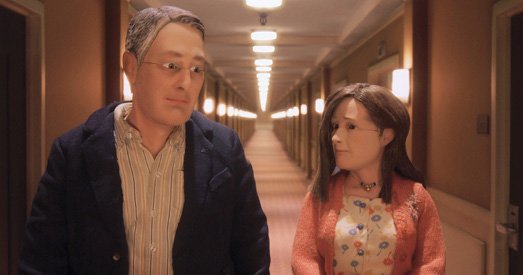
No one writes like Charlie Kaufman, and few writers seem to grasp the human condition as well as he does. His latest, co-directed by Duke Johnson, uses puppets to create a wholly unique world of loneliness. The movie is filled with identifiable moments, both hilarious and achingly sad, each done in a way that is original and often breathtaking. Kaufman is perhaps our greatest cinematic voice. It's wishful thinking, but I hope we get a dozen more movies out of him.


2) Mad Max: Fury Road dir. George Miller

What can I possibly say about this movie that hasn't already been conveyed? Aside from witnessing some of the most explosive action ever put on screen, Fury Road also boasts the presence of Imperator Furiosa, a force of nature played by Charlize Theron. She's the real hero of the movie, filled with hope and willing to fight for it, regardless of the cost. It's not often action can be a narrative drive and build character, but I'll be damned if Fury Road doesn't succeed tenfold. Even at 70, George Miller continues to prove he is one of our most versatile and groundbreaking directors.


1) Chi-Raq dir. Spike Lee

Seeing Do the Right Thing as an early teen changed my life as a movie watcher. From a technical standpoint, it was like nothing I'd ever seen (I became obsessed with dutch angles), but what stood out most was how director Spike Lee was able to effortlessly marry tones of anger and playfulness. It's probably my favorite movie, one that I watch at least once a year. I've followed Lee's career since with great enthusiasm, despite its unevenness. When he hits, he hits hard, but as he approached middle age, it seems as if some of that spark he had early on disappeared. The first time in a long while I found traces of it again was in his criminally underestimated remake of Oldboy, in which Lee staged some of the most furiously charged sequences of his career. Now comes Chi-Raq, which reminds of the brilliance of his early work in almost every way. Like the movies of Lee's we know and love the best, Chi-Raq combines outrage with vivacity. It might not be done as seamlessly as it was before (tonally, the movie is all over the place), but that's a detail easy to overlook due to the fact that this is the most ambitious and lively and purely entertaining movie I have seen in some time. Like Lee's best movies, it is deadly serious about its agenda and feeds it to us with the largest fork imaginable. We don't choke because what he is presenting, gang violence in Chicago, is a serious issue and because the alternative suggested to fix it (Lysistrata by Aristophanes is the basis) is wonderfully absurd. The movie boasts a series of epic performances, the most noteworthy being Teyonah Parris as the leader of the rebellion and John Cusack as Father Mike Corridan (the character is based on a real Chicago minister). I was overwhelmed throughout the entire run time of Chi-Raq, but always confident that I was in the hands of someone who wanted to teach me, challenge me, and entertain me. Chi-Raq does all of those things and is a long overdue return to form from one of our most vital, talented, and gusty filmmakers. I'm so grateful to have him, and I'm overjoyed to have a movie as batshit crazy and alive as Chi-Raq.


Thank you for visiting Hell and Beyond!


(c) Hell and Beyond, 2016

Friday, November 20, 2015

Indie Memphis Film Festival '15: Duke Johnson and Charlie Kaufman's Anomalisa


I have a hard time writing about Charlie Kaufman's work. His directorial debut, Synecdoche, NY, is a movie that bulldozes me every time I see it. I've been wanting to write about it for the past seven years, and always just end up staring at a blank screen. Part of me is afraid that instead of writing about the movie proper, I'll spend too much time discussing the number of scenes that I could apply to my own life. There's an unflinching cynicism to Kaufman's screenplays, so much so that many are turned off and repelled by them. Look deeper and you'll find buried beneath an honesty that is so raw and true that it's painful to admit how much it resembles staring at yourself in a mirror. As evident as the pain is in Kaufman's world, there is also plenty of rich humor based on the misunderstandings and stubbornness we possess by being human. His insight into what makes us tick is explored in ways that are startlingly fresh.

Kaufman's latest, Anomalisa, which he co-directed with Duke Johnson, features a cast made up completely of puppets created using a 3D printer. This approach has allowed Kaufman to take this material (based on a play he wrote) and explore it with an extraordinary amount of freedom. The result is exhilarating and devastating in equal measure, as Kaufman breaths new life into the power of animation and is able to, in the way only he can, create complex and sympathetic characters despite their strange and somewhat unsettling look. Even with puppets, Kaufman is able to pull off numerous scenes in the movie that are almost unbearably heartbreaking.

I am hesitant to get into the details of Anomalisa. Like all of Kaufman's work, it is best to go in with a limited amount of information and be caught off guard by the endlessly creative ways he is able to develop his characters and their feelings. Watching the movie, there are many cases where a scene could easily dissolve into cheap melodrama and in lesser hands, it probably would. But Kaufman is always one step ahead of us, ready to pull back another layer to reveal something that is as surprising as it is familiar. The method in which he gives his characters their voices is as brilliant as anything he has ever done in terms of how it affects the bigger picture.

Anomalisa is a true work of art, challenging, funny, hopelessly relatable, and sad as only the best works of art can be. The weight of Kaufman's world becomes ours, and while it certainly isn't an easy burden to share, the rewards of doing so are rich and unforgettable. No one else makes movies like this, or really ever has. Nor has anyone else had the guts to try. What I'm saying is that Kaufman is a treasure and we're lucky to have him. Here's hoping that all the positive buzz Anomalisa has generated will keep us from waiting seven more years before his next movie. I don't think I could bear it.


Thank you for visiting Hell and Beyond!

(c)Hell and Beyond, 2015